
Human Superiority?
Embarrassed into the new year

A short note on that specific essay:
I will not soften these words.
I won’t take the painful edges off.
I won’t counterbalance them with our beauty, our art, our tenderness.
I’ll allow what survives in nature:
claws, teeth, speed, wings, raw senses, pre-verbal instinct.
This is not a comfortable essay. Not a positive one. Not a accomplishing one.
It doesn’t just stir the storm.
It is a kind of storm.
I sit here after having flown together and structured fragments of conversations in real life and here on substack ( a thank you to Tamara for your ever inspiring sharpness!), a documentary about e-cars, the recognition of what happened with nature and wildlife- even in cities- when we were forced to lock us down within our four walls in the pandemic, occasional streams- or rants-of thought when walking.
I am not exempt or more enlightened or whatsoever than any other human or being, but I stepped out of a fundamental illusion.
And after writing this, having it stretched out in front of me, I feel unsurprisingly shocked, embarrassed and disillusioned- and strangely liberated at the same time.
Nature is stronger than us.
And more intelligent.

Driving home from the very little farm of a befriended family, something came up almost casually - and then landed hard:
The earth doesn’t need us.
We - the human species - are useless for the earth.
That doesn’t mean meaningless.
It means functionally irrelevant.
Almost every other species plays a small, precise role in a complex, interwoven ecosystem. Not heroically. Not consciously. Simply by being what it is.
We don’t.
We are the only species that reliably fucks things up and then feels proud for trying to fix what we broke.
From the perspective of the planet, Homo sapiens is not what is needed.
That may sound brutal.
It is.
And yes - I belong to this species too.
If I look at the planet as a whole, without romance, without human sentimentality, we are not caretakers. We are not stewards. We are not wise.
We are a disturbance.
And maybe that’s already uncomfortable: how quickly critique of the species is taken as a personal insult.
That, too, is part of the problem.
What we call intelligence - or maybe this fata morgana we call ego - blocks neutral, cruel clarity.
The earth is neutral.
Cruel.
Unforgiving.
It doesn’t care if we feel special.
Are you still comfortable in your seat? Or is something itching?
Good.
Feel it.
In your fucking great human body.
Show me another species that creates wars.
Not fights - wars.
Wars to conquer, dominate, erase.
Because of religion.
Because of skin colour.
Because of ideology.
Because of the idea of being better.
There is no species that kills because of so-called “love.”
No species with this level of mental illness, addiction, self-destruction.
No species that downgrades all others as inferior.
No species this disconnected from nature, stuck in a hallucinated separate self, endlessly circling around itself.
No species this judgemental.
And if we write poetry, philosophy, self-help, manifestos - without touching this illusion - our words are just another workaround. Another loop. Another self-soothing story.

I don’t write this because I hate humans.
But I’m not proud to belong to this species either.
I didn’t choose to incarnate in this body. But I can stop lying to myself.
That isn’t anti-human. It’s anti-delusion.
We are obsessed with hierarchies. With “higher” and “lower.” With dominance disguised as intelligence.
Stripped of embodiment.
Stripped of instinct.
Stripped of humility.
Here’s a part that matters:
The problem is not the functions of our brain, the problem is not its ability for abstraction.
Abstraction is a survival adaptation.
The problem is abstraction that forgot the body. Forgot felt sense. Forgot natural intelligence.
Forgot seasons, cycles and the whole.
What is expected, trumpeted, lived socially mostly doesn't actually fit the natural Rhythms. And we aren't some mind ideas, but natural beings. The trees, flowers, beings are not always flourishing, not always striving.
Short: what we do is abstraction without adaption.
And then we blame life - and our bodies - for not complying.
We call ourselves complex and intelligent while flattening human life into marketable slogans focusing on: positivity, growth, age, resilience, the higher self (of course, a simple self is not enough, let alone a just being here). Platitudes everywhere.
We confuse dominance with wisdom.
Speed, Accumulation and Numbers with intelligence.
Constant output with meaning.
Probably we confuse much more, but I simply admit that I am confused-and a bit tired. And thus leave it up to you to sharply find more detailed confusion.
We think we are superior while becoming increasingly anxious, ill, disconnected, brittle.

Therefore…
I don’t believe we will save the planet.
That belief is absurdly arrogant.
The earth has always changed. Long before us. Without us.
There was ice.
There were droughts.
There were floods.
Entire continents disappeared and reappeared elsewhere.
We weren’t even around!
Climate change is not new. Our panic about control is. The planet will take care of itself.
It always has.
What it may not tolerate indefinitely is us.
Bacteria existed before us.
Viruses existed before us.
Single-celled organisms are the biological basis of everything we call life if am not mistaken.
We host billions of them - not because we’re dirty, but because that’s biology.
And as much as I love my body, being a wonder:
from a survival perspective, it’s a bad design.
No fur.
Slow.
Mediocre senses.
Babies helpless for years.
A naked, awkward animal on an unforgiving planet.
As hinted before: from an evolutionary perspective, the brain became our compensatory organ. What the body could not do, cognition had to attempt. Planning. Abstraction. Prediction. Social coordination. Tool use. Language.
Our brains didn’t expand because we were superior - they expanded because otherwise we would have died out long ago. The prefrontal cortex was an emergency solution.
And in that emergency, another malfunction settled in.
We started circling around ourselves, in our minds, spoken and unspoken - and believing this is the real shit!
Now, with all our grand inventions, most humans have a concentration span shorter than a fruit fly - which at least has a 360-degree view and processes visual information faster than our nervous system ever could. And as you see, we even judge with our language metaphors some other species. And not realising that we actually insult qualities or capacities in regards to worth, intelligence, bonding, consent, aggression, hygiene, and so on those animals excel at. Some more examples:
“Birdbrain” – many birds outperform humans in spatial memory and problem-solving.
“Dumb as a cow” – animals with complex social bonds, memory, and emotional attunement.
“Like animals” (about sex) – despite many animals having nuanced mating rituals and consent cues.
“Dirty as a pig” – pigs are fastidiously clean when allowed natural conditions, muddying is intelligently used to protect from sun and parasites as well as to regulate body temperature.
“Blind as a bat” – bats navigate via echolocation with extreme precision.
”Lazy as a sloth” – sloths are energy-efficient, not lazy. They move only when needed, hang upside down without effort, and even can hold their breath longer than dolphins (up to 40 minutes I read!). They are so still, algae create tiny ecosystems in their fur.
And our biggest accomplishment as a species?
We create problems where there were none.
Then we invent solutions that create new problems.
Then we applaud ourselves.
Repeat.
We call this progress.
Simplified Example (of probably so many examples that they could fill a book trilogy):
We can’t run fast.
We can’t fly.
We also can’t swim too good.
So we invent ships, cars, planes. We extract resources. We poison ecosystems.
Then we panic.
Then we invent “solutions.”
Electric cars. Green technologies. Recycling rituals.
Big applause.
But such a solution needs resources.
Lithium. Cobalt. Nickel.
They are torn out of the ground - often in the Congo - through landscapes that become uninhabitable, through bodies that absorb the cost and kill each other for the money involved. Poisoned water. Destroyed soil. Child labour. Displacement. Silence.
All so we can feel cleaner while driving.
And when the batteries die?
No one really knows where all of them will go.
We just assume there will be another solution by then.
This is the ongoing pattern.
Applause?
We forget - conveniently - that most of our solutions are only needed because we created a problem in the first place.
Lets be painfully honest here:
It then feels better or more comfortable to believe we’re saving the world than to admit that we are a quite fucked up species and what we are actually doing is desperately trying to delay our own extinction.
The earth existed before us.
It will exist after us.
Buffalos will likely outlive us. ( If we do not kill them)
Crocodiles will. (If we do not kill them)
Insects certainly will. (harder one in regards to killing…)
We are not the crown of creation.
We are a blinking fart in the vast ocean of the universe.
If we disappear, the planet won’t mourn. If the planet disappears, the universe won’t notice.
There was fire.
There will be fire.
There was ice.
There will be ice.
There won’t be an end of the earth or maybe sometimes there will.
But there will be an end to human-made problems and our pride in solving them.
We’re on a fast track to extinction.
How fast - I don’t know.
But compared to the age of this planet: probably very fast.
Maybe we’ll be defeated by nature.
Maybe we’ll extinguish ourselves.
And maybe we’ll disappear still convinced of our superiority.
With pride and glory.
A last fanfare tatatataaa.
This isn’t an answer.
This is surely no solution, and to be clear - I don’t have one.
It’s a refusal. An outcry, maybe.
Incomplete. Ghostlike. A breath dissolving into frosty air.
And if it leaves you quietly rattled or disturbed -
good.
Because maybe intelligence doesn’t begin with being better than everything else.
Maybe it begins when we finally, uncomfortably, understand and feel in our cells
that being alive and being part of life
was never the same as being above it.
Fiercely and humbly,
Karin
There was a time in my life when I would never have dared to write something like this - controversial, provocative, but true to myself - in public. Maybe I would even have blamed myself for thinking this way.
But about eleven years ago, in a time of great inner turmoil, within a love that defied definitions, I started to speak in my own voice. Unfiltered, raw, sometimes beautiful, sometimes not. To one person. I wrote myself bare.
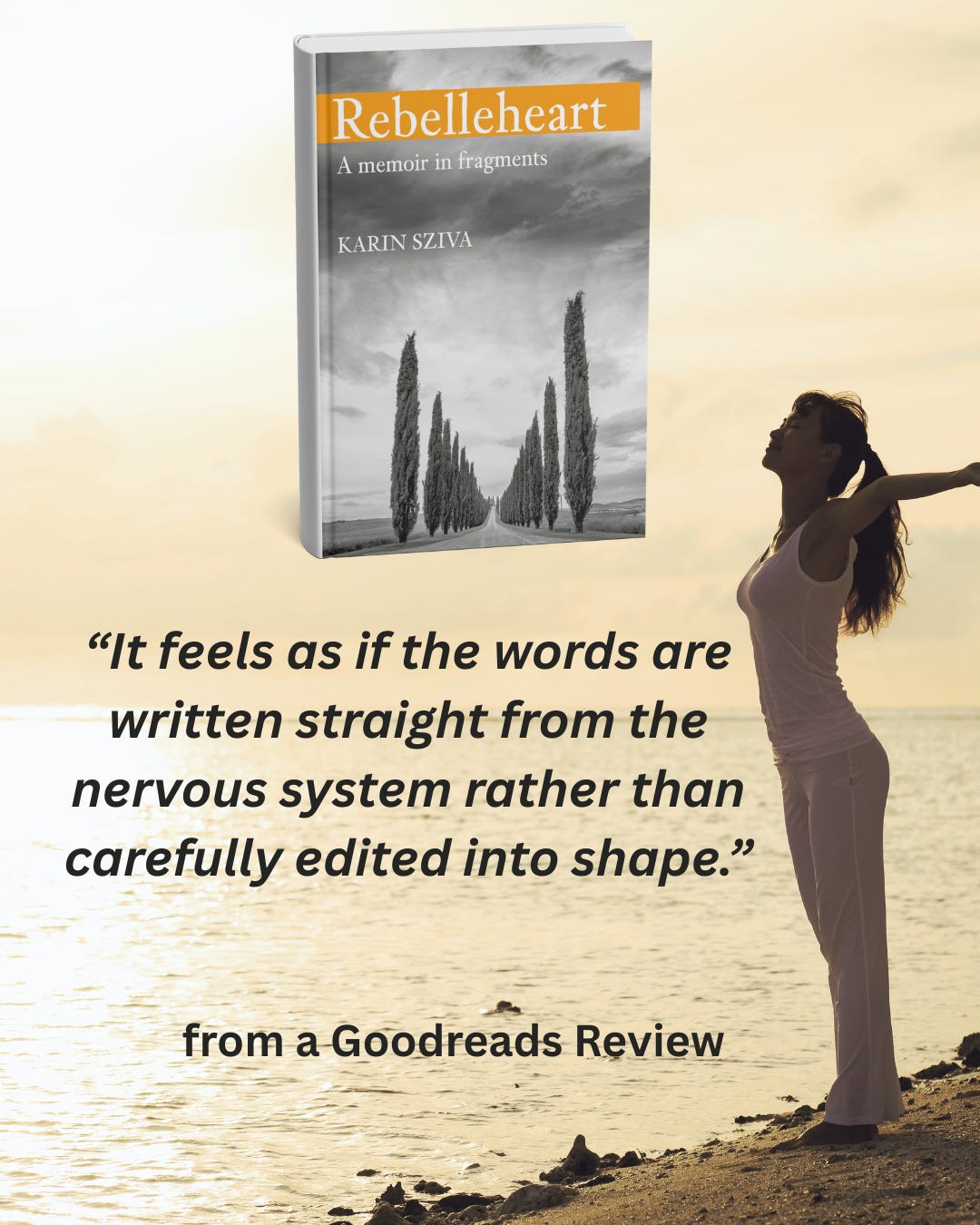
Some of those letters, reflections, and confessions are in my debut book Rebelleheart – A Memoir in Fragments.
The ebook is already available worldwide on Amazon. The print versions will follow at the end of January 2026.
Below a very short excerpt of dear Substacker Sean Grogans review of Rebelleheart. Thank you!
You've left me with so much to think about. Thank you!!
This is very interesting.
I completely agree that we can't save the planet; we are dependent on it, while it isn't dependent on us. We've put ourselves in jeopardy, and that's what we're either panicking about or outright denying, depending on political partisanship or scientific literacy. I also think our notions of human superiority are self-evidently fallacious, as they are entirely self-serving and presuppose human exceptionalism and some objective value about human beings that doesn't exist.
All systems exist to replicate themselves, so the question is what is natural? We can be natural and also parasitic, because parasites are a part of the cycle. And then we have the naturalistic fallacy that presumes there's something inherently good or superior about what is natural, combined with the fact that all value judgments are subjective anyway, and don't exist outside of our consciousness. We are simply constrained by our inability to think about these things without being self-referential, and it's that prism itself that makes us different from other animals; different, but not necessarily superior, as you point out.
I find myself asking more questions I don't have the answers to, which is a sign that you've done your job as a writer. It's a great piece, and I know how difficult it is to write something like this.